Breathing tests have always relied on one assumption. The patient can perform them correctly. However, in real clinical settings, this is not always the case.
This is exactly why the Forced Oscillation Technique device is gaining attention across respiratory care. It shifts the focus away from effort and toward observation. Instead of asking the lungs to perform, it studies how they behave during normal breathing.
That shift matters more for some patients than others. In certain cases, it brings clarity where traditional testing falls short. Here are some patients that benefit from FOT device far more than others.
Patients Who Struggle with Effort-Based Tests
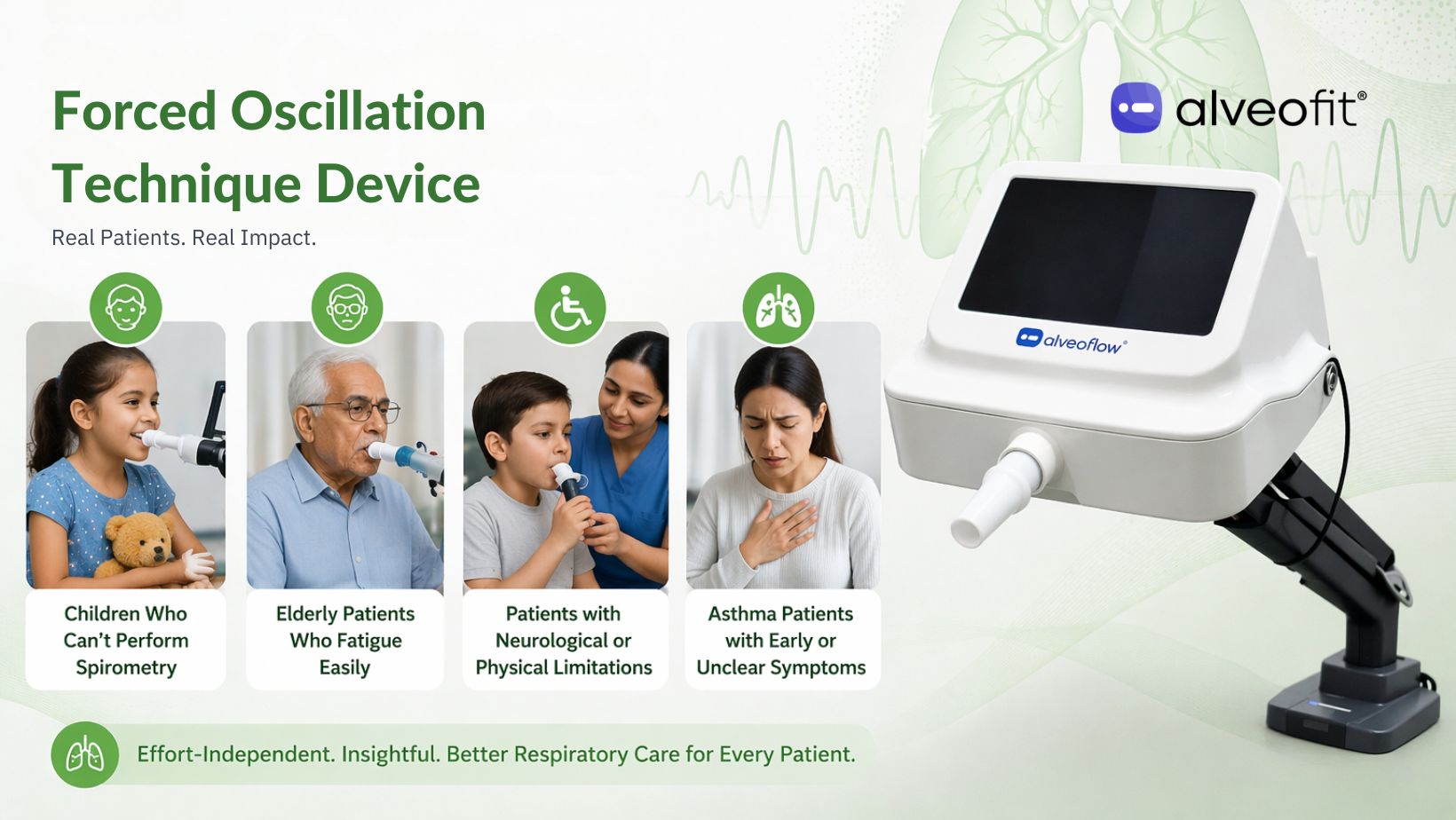
Every patient is not capable of performing spirometry in a way that produces reliable results. The challenge here is not the condition itself, but the effort the test demands. This is especially true for:
- Young children who cannot follow structured breathing instructions consistently
- Elderly individuals who tend to fatigue during repeated breathing efforts
- Patients with neurological or physical limitations that affect coordination or strength
In all of these cases, the limitation is not always lung function. It is sometimes the ability to perform the test correctly.
Spirometry relies heavily on controlled effort. The patient is expected to inhale deeply and then exhale with a specific force and timing. The readings can become inconsistent or difficult to interpret when this sequence is not performed accurately. Even small variations in technique can influence the outcome.
A Forced Oscillation Technique device shifts this approach entirely. The test does not simply depend on the effort put in by the patient. Instead, it allows the patient to breathe in a calm and natural manner. The patient does not need to force breathing. They need to breathe normally; the device does the rest by capturing how the airways respond.
This change removes the dependency on performance and replaces it with observation. For these patients, the value from the Forced Oscillation Technique device is not just ease of testing. It is the ability to obtain results that are consistent, repeatable, and more reflective of how the lungs actually behave.
Asthma Patients with Unclear or Early Symptoms
Asthma does not always present itself in clear or obvious ways. In many cases, the early signs are subtle and easy to overlook.
During this phase, some patients may notice mild chest tightness. They notice a slightly slower recovery after physical activity. They may even experience occasional breathing discomfort that comes and goes. These changes can feel inconsistent, and at times, not severe enough to raise immediate concern.
The problem is that these patients may take a spirometry test. But the results from them often still fall within normal limits. This is where uncertainty begins to build. The symptoms feel real, but the data does not fully reflect what the patient is experiencing.
The reason isn’t a broken machine or wrong testing. Instead, the reason often lies in where these changes begin. Early asthma tends to affect the smaller airways first. Subtle shifts in resistance and elasticity in these areas may not always be captured through force-dependent testing.
A Forced Oscillation Technique device helps bring clarity to this phase. Instead of relying on forced breathing, it measures how the airways behave during normal, quiet breathing. This allows it to detect subtle mechanical changes that may otherwise go unnoticed.
This makes it particularly valuable for:
- Patients in the early stages of asthma
- Individuals experiencing mild or intermittent symptoms
- Ongoing monitoring of how the airways respond to treatment over time
Thanks to the FOT device, clinicians are no longer required to wait for symptoms to worsen or for spirometry values to decline. Today, they can identify and respond to these changes sooner. Moreover, the Forced Oscillation Technique device helps offer a clearer understanding of what is happening within the airways.
Conclusion
The scope of a Forced Oscillation Technique device extends beyond the patients discussed here. It proves valuable during post-infection recovery and long-term respiratory monitoring. Early or subtle changes often go unnoticed in these scenarios. However, the FOT device changes that.
What remains consistent across all these scenarios is the need for reliable, effort-independent insight. A Forced Oscillation Technique device does not rely on how well a patient performs the test. Instead, it captures how the airways behave during natural breathing. This makes the results more consistent and easier to interpret in real clinical settings.
This is where solutions like alveoflow stand out. Our FOT device is designed to deliver consistent and clinically meaningful data. It supports smarter decision-making and helps forward-thinking clinics strengthen diagnosis and patient care.